Friday, September 7, 2018

Love is the resistance


I read Resistance by Jennifer A Nielsen this week. After reading A Night Divided, I couldn't wait for Jennifer Nielsen's next book. Resistance does not disappoint.

This book is about the Jewish resistance fighters during World War II. Chaya is a courier. She's a jewish teen posing as Polish. There are horrors, injustices, and grief as can be expected in historical fiction based on the Holocaust.

I loved the cover (reminiscent of Tiananmen Square tank man). A teenage girl, knowing success is unlikely, but ready to take on evil.

Some of my favorite parts:

Her eyes widened as she looked back at me. "What if they truly are winning, Chaya? What happens then?" 
I'd asked myself that same question countless times. If they won, the extermination that began with us would extend to anyone they viewed as a threat to their twisted ideals. If there was any chance of them winning, then the resistance mattered more than ever. 


"The Nazis murder us many times over. They take our ability to worship properly - a spiritual death. They separate our families - another death there. They kill our dignity, our will to live, and finally they take our lives. The question isn't whether my family is gone. It's only a matter of how many deaths they've suffered so far." 


Historians might say that the Jews lost every uprising we attempted in this war, that every resistance movement failed. 
I disagree. 
We proved that there was value in faith. There was value in loyalty. And that a righteous resistance was victory in itself, no matter the outcome. 
We got our three lines of history.

Be sure to read the AFTERWORD from the author. There is more information about AKIVA, ZOB, and the Couriers. Most were just teenagers and young adults.

From the Afterword:

May we never forget. May we live with honor at all times, regardless of our circumstances. And may we choose love, a weapon that will defeat hate every single time. 
Love is the resistance.


Look up more information online...

The Cyganeria Cafe attack


Lodz Ghetto


Warsaw Ghetto Uprising 

Tuesday, August 21, 2018

no human being is illegal


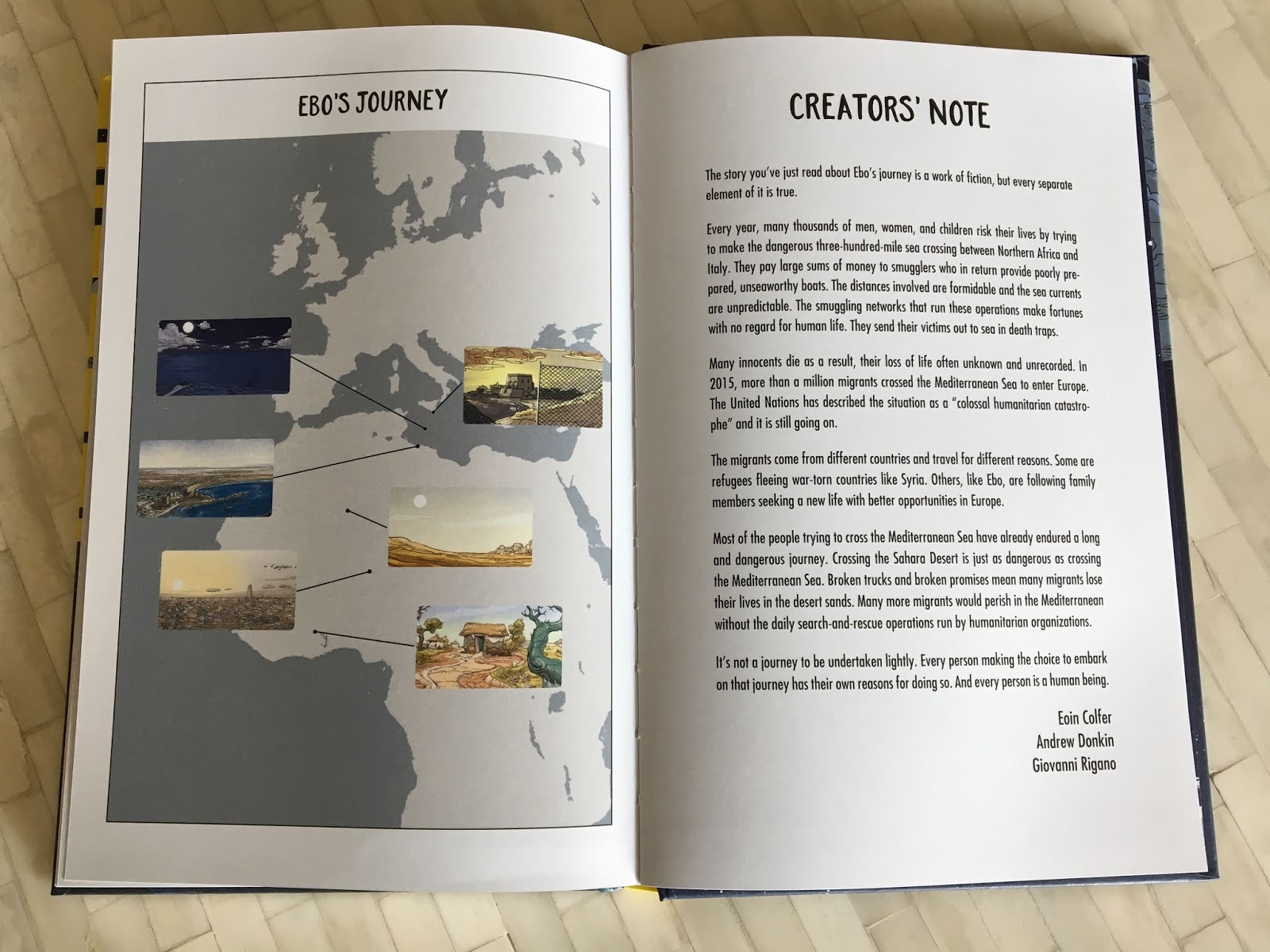
 I just read the new graphic novel, Illegal, by Eoin Colfer. This middle grade, graphic novel is about one boy's journey across Africa with the hope to reach Europe.The novel puts a human face to the European migrant crisis.


From Publishers Weekly:
The book's title is arguably provocative, however. "Illegal is quite a controversial word in this context," Colfer says. "Often migrants are referred to as illegal, but the children cannot understand how they can be illegal for simply existing on planet Earth." Colfer adds that he and Donkin took the title from a quote by author and Holocaust survivor Elie Wiesel, which begins, "You who are so-called illegal aliens must know that no human being is ‘illegal.' That is a contradiction in terms."

This is a gripping story about twelve-year-old Ebo's epic journey from Africa to Italy. The graphic novel is grueling. The illustrations are beautiful and terrifying. You will feel what it's like to be thirsty in the desert, freezing at sea, and continually afraid.

The quote from Elie Wiesel in the introduction:


"You, who are so-called Illegal Aliens, must know that no human being is Illegal. This is a contradiction in terms. Human beings can be beautiful or more beautiful, they can be fat or skinny, they can be right or wrong, but Illegal? How can a human being be Illegal?"

In the epilogue, readers are reminded that in 2015 alone, more than one million migrants crossed the Mediterranean Sea to enter Europe. The United Nations has described the situation as a "colossal humanitarian catastrophe".

This book would be perfectly paired with Refugee by Alan Gratz and/or Home Of The Brave by Katherine Applegate.

Sunday, August 19, 2018

always sweeter

A book was delivered to my doorstep this weekend. I must have preordered it months ago on someone's recommendation. It is Adrian Simcox Does Not Have A Horse by Marcy Campbell.


It is a beautiful story that will start a wonderful conversation about empathy. Readers will see that understanding is always sweeter than judgement. 


This book is an imaginative and creative way to teach kids (and adults) about compassion and kindness. 


"I also thought, he had the most beautiful horse of anyone, anywhere."


This book would be a great way to start the school year.


Tuesday, August 14, 2018

for every soon-to-be voter

"We the people of the United States, in Order to form a more perfect Union, establish Justice, insure domestic Tranquility, provide for the common defense, promote the general Welfare, and secure the Blessing of Liberty to ourselves and our Posterity, do ordain and establish this Constitution for the United States of America."


This past week, while traveling, I read Fault Lines In The Constitution: The Framers, Their Fights, And The Flaws That Affect Us All by Cynthia Levinson and Sanford Levinson. 

I learned so much about the United States Constitution... and its flaws, ambiguities, and compromises. This book is timely, as it turns out that many of the issues we struggle with today have their roots in the creation of the U.S. Constitution.

I loved the layout of this book: the large print, graphics, quotes, and inserts are engaging. From the 'Preamble' to 'Now What?', this book walks the reader through the structures of our government and its limitations.


My favorite part of the book is Part VII - Keeping Pace with the Times.


Alexander Hamilton wrote that ordinary Americans had the opportunity to participate in "reflection and choice" about how they wished to be governed. The First Congress took him up on that offer in 1789 by proposing the series of amendments called the Bill of Rights.

I loved the 'grading' breakdown of the Constitution based on the goals of the preamble: form a more perfect union, establish justice, insure domestic tranquility, provide for the common defense, promote the general welfare, and secure the blessings of liberty to ourselves and our posterity.


This is a fantastic book for every young adult reader, every soon-to-be voter, and every American citizen.

For more information, check out the Fault Lines website.


Monday, June 25, 2018

Read books. Care about things.

I know a reluctant reader who is headed into 8th grade. Here are the books I am sending to her this summer:

All Summer Long by Hope Larson
Rain Reign by Ann M Martin
A Night Divided by Jennifer A Nielsen
The War That Saved My Life by Kimberly Brubaker Bradley
Be Prepared by Vera Brosgol
Fish In A Tree by Lynda Mullaly Hunt
In Real Life by Cory Doctorow & Jen Wang
Amulet by Kazu Kibuishi
Paper Wishes by Lois Sepahban
Patina by Jason Reynolds
Long Way Down by Jason Reynolds
The Crossover by Kwame Alexander
Sisters by Raina Telgemeier
Page by Paige by Laura Lee Gulledge


I just read a book myself that had this quote by Hank Green in it:


Read books.
Care about things.
Get excited.
Try not to be too down on yourself.
Enjoy the ever present game of knowing.
-Hank Green


In our world today, I don't think there could be better advice ... whether you are 13 or 103.

Reading is a curious act. Reading helps us develop empathy. When we read, we are better able to champion narratives of humanity from across the globe, as well as see ourselves reflected back to us.

Enjoy your summer reading.
And, remember to care about things.


Sunday, June 24, 2018

Tonight Show Book Club

The Tonight Show's Jimmy Fallon announces the Tonight Show Summer Reads...


Choose one of these five books for the Tonight Show Book Club summer read.

You can cast your vote at tonightshow.com/summerreads

The Good Son by You-Jeong Jeong
IQ by Joe Ide
Providence by Caroline Kepnes
Children Of Blood and Bone by Tomi Adeyemi
The Immoralists by Chloe Benjamin


Wednesday, June 20, 2018

World Refugee Day

Today is World Refugee Day.

What does it mean to be a refugee...


Maybe you saw this post today on Facebook by former President Barack Obama:


My favorite parts of his post:

...are we a nation that accepts the cruelty of ripping children from their parents’ arms, or are we a nation that values families, and works to keep them together? Do we look away, or do we choose to see something of ourselves and our children?
To be an American is to have a shared commitment to an ideal – that all of us are created equal, and all of us deserve the chance to become something better.
That’s the legacy our parents and grandparents and generations before created for us, and it’s something we have to protect for the generations to come. But we have to do more than say “this isn’t who we are.” We have to prove it – through our policies, our laws, our actions, and our votes.

My two favorite books on this topic are REFUGEE by Alan Gratz and Home of the Brave by Katherine Applegate.


From TEDEd:
To learn more about global forced displacement, a good place to start is the website of the UN Refugee Agency (UNHCR). This includes plenty of information and resources; including a basic explanation of the Refugee Convention and an annual report on patterns of forced displacement. The website also looks at individual stories, trying to match the statistical data with more personal accounts of displacement. 

To further investigate the challenges faced by those who seek to begin a journey from war to safety, the missing migrants project looks broadly at those—both migrants and refugees—who have died along migratory routes (both at land and at sea). For more detailed information, you can read this report by the International Organization for Migration

In this TED Talk, Melissa Fleming (UNHCR) tells the story of two refugees and their harrowing journey towards safety. In another important TED Talk (and written article) journalist Anders Fjellberg and photographer Tomm Christiansen remind us of the personal nature of these stories, writing that “everybody has a name, everybody has a story and everybody is someone.” In this interview with Antonio Guterres, the former High Commissioner of UNHCR, Guterres calls for a multilateral turn toward acceptance and respect. 

It is important to realize that arriving at the destination and obtaining refugee status does not mean the end of problems. Refugees and IDPs in camps often face difficult conditions, including limited infrastructure, overcrowding, temporary shelter with inadequate insulation/protection from the weather, lack of economic opportunities and/or education. Psychologically, life in a camp can be highly alienating and take a heavy toll. 

Refugees living outside of camps also face hurdles including gaining access to health, education and other social services, and finding adequate shelter. Refugees are frequently in need of assistance for rent, and financial considerations can prevent them from finding adequate housing, forcing them to live in substandard accommodations such as abandoned or unfinished buildings or in informal dwellings.  These run the risk of lacking adequate access to water, sanitation, waste management, or electricity and are unfit for the winter season. 

Finding a job is often one of the most complex and difficult tasks, even though refugees may have had access to a good education in their home countries or had jobs that require a high level of education.  And even for those refugees that obtain asylum in a country where more socio-economic assistance may be available, the trauma of having to rebuild a life and integrate in a very different context is a major challenge.

At the same time, we should keep in mind that refugees are courageous and strong human beings with their own unique skills and talents and with the ability to make plenty of positive contributions to their host countries. They have a lot to offer to their host societies and their full potential should be embraced. Here you can find a few ways through which you can help and empower refugees in your city or country. 


Currently, the United States government is separating families of refugees, asylum seekers, and migrants at the border. To find out more about what's going on on America's southern border, click HERE.

Questions:

What do you think it means to be a refugee?

What do you think it means to be an American?

When former president Obama says:
After all, almost all of us were strangers once, too. Whether our families crossed the Atlantic, the Pacific, or the Rio Grande, we’re only here because this country welcomed them in, and taught them that to be an American is about something more than what we look like, how our last names sound, or the way we worship. To be an American is to have a shared commitment to an ideal – that all of us are created equal, and all of us deserve the chance to become something better.
... can you trace back in your family's history to when your family was a stranger in America?

What are your favorite books on this topic?

Thanks!